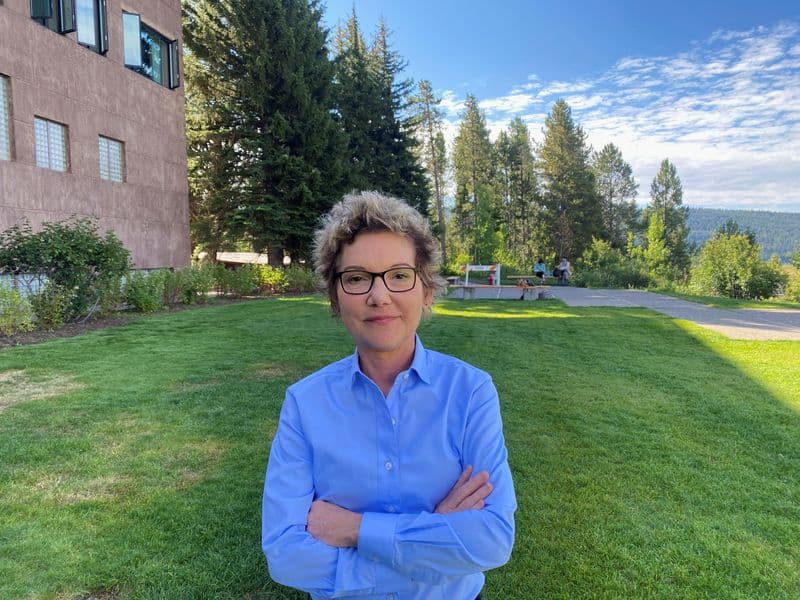
Mary Daly, President of the Federal Reserve Bank of San Francisco,
stated on Thursday that the central bank will likely need to raise interest rates further to combat high inflation, though she noted there is no urgent need to act immediately.
"My bias is that we will need more policy tightening," Daly said at an event hosted by the Stanford Institute for Economic Policy Research. She pointed out that price pressures are spreading beyond energy and goods into the services sector, where inflation tends to be more persistent.
Daly welcomed the rise in bond yields and the tightening of financial conditions, noting that these developments "give us a little more time to make really thoughtful decisions."
The Fed official stated that artificial intelligence is contributing only modestly to inflation and has a limited impact on the labor market. "We have an inflation problem, but AI is not the primary driver of it," Daly said.
She highlighted positive trends in labor productivity, noting that ongoing work suggests the potential for stronger productivity growth over the next one to three years. Daly added that the recent repricing of AI-related assets does not signal a decline in interest or enthusiasm for the field, nor does it pose a risk to economic growth.
According to Daly, the current economic landscape features a stable labor market, positive economic growth, and rising labor productivity—all occurring against a backdrop of high inflation. "The focus needs to be on bringing inflation down," she asserted.
Daly warned that inflationary shocks can compound, and she urged against complacency. "Once inflation in the services sector begins to rise, it tends to become persistent," she observed. According to Daly, financial markets are currently broadly in line with the conditions the Federal Reserve is aiming for; she added that tighter financial conditions provide the central bank with more time to make monetary policy decisions. She noted that the precise timing and scale of any further Fed policy tightening do not need to be determined immediately.
"We have many more quarters ahead to make monetary policy decisions," Daly stated.
She described the current environment as a "perfect storm for hiring," citing artificial intelligence, uncertainty, and rising costs as factors that are dampening hiring activity.