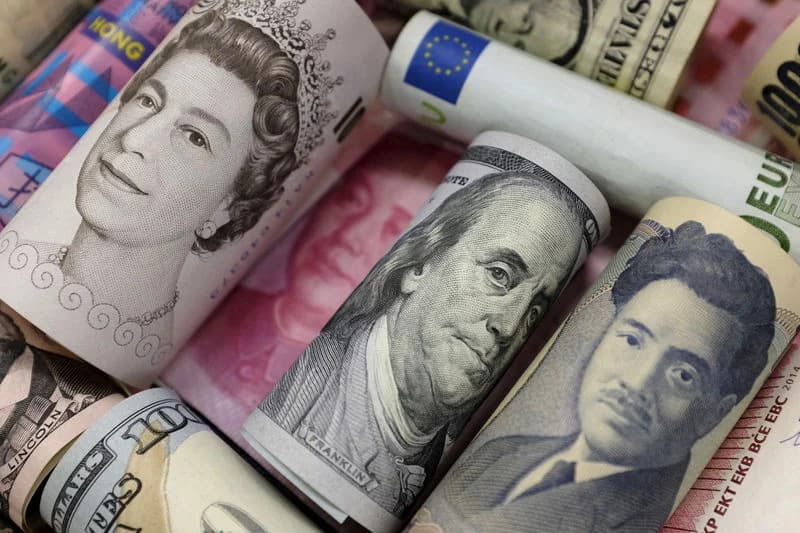
On Wednesday, the pound sterling traded lower, and the euro also declined, as high US inflation and hawkish comments from the Federal Reserve pushed the dollar to its highest levels of the year.
As of 12:20 Moscow time, the pound sterling was down 0.16% at $1.3319, while the euro had fallen 0.21% to $1.1142.
"A 'bearish flattening' of the US Treasury yield curve, occurring as the Fed shifts toward a restrictive monetary policy, tends to be favorable for the dollar against currencies that are sensitive to economic activity," said Chris Turner, global head of markets strategy at ING.
"We expect the dollar to remain strong and to test the upper limits of its trading ranges in the coming weeks," he added.
According to Turner, the US Dollar Index could soon retest "major resistance" in the 102.85–103.00 range. Data from HSBC shows the index stood at 102.20 on Tuesday.
In a hawkish statement, Federal Reserve Governor Chris Waller indicated that he would support a 25-basis-point rate hike on December 9—and potentially a 50-basis-point increase if October inflation data were to come in high for the third consecutive month. The data did indeed come in high; however, analysts at ING believe that a 50-basis-point move might prove too aggressive for many of the voting members of the FOMC. According to ING, yields on short-term Treasury bonds have risen by approximately 20 basis points, and the spread between 2-year and 10-year notes has narrowed by 7 basis points—though ING’s rates desk estimates that 2-year yields have climbed by 13 basis points since its last update.
"A core consumer price index (CPI) reading of 0.3% month-on-month translates to an annualized inflation rate well above 3%," noted Michiel Tukker, a senior rates strategist at ING, who expects 10-year Treasury yields to return to 5%. Markets are currently pricing in a rate hike of more than 25 basis points for December.
Tukker anticipates a 25-basis-point increase, with no further hikes expected until 2027. The next catalyst will be the release of the Producer Price Index (PPI) for October this Friday. U.S. markets are closed for Veterans Day, which may result in low liquidity.
Clare Lombardelli, Deputy Governor of the Bank of England—who last week joined an 8-to-1 majority in voting to raise interest rates from 3.75% to 4%—stated on Tuesday that "the conditions for a sustainable inflation dynamic in the medium term are already taking shape." She made these remarks during a speech at a central banking conference hosted by King’s Business School and the Money, Macro & Finance Society. Responding to a question about her future voting intentions, she stated that she "would not rule out either the December or the February meeting," adding that every meeting remains "on the table."
In a separate interview with The Guardian, also published on Tuesday, she remarked that she "would not rule out" a rate hike in December, though she added: "At the same time, I don't have enough information yet."
Regarding the euro, Turner from ING noted that the 1.1110 level—a 50% retracement of the rally from March 25 to January 26—"is likely a good point for speculative investors to take profit on short positions in the EUR/USD pair." He added that "the case for a rebound from this support zone is weak."
ING expects the ECB to follow the Federal Reserve’s lead and raise rates to 2.75% on December 17; however, they consider the arguments for a prolonged tightening cycle by the ECB to be significantly less compelling. The bank anticipates that the EUR/USD pair will trade within a range of 1.1140 to 1.1200 today. Speeches are expected from ECB officials Cipollone, Kazaks, Nagel, and Lagarde.
Turner expects the EUR/USD pair to be "approaching the lower end of the 1.10–1.15 range" by the end of the year, even though December seasonality is typically favorable for the euro.
Weaker U.S. price data—such as a low Producer Price Index (PPI) reading—could call this scenario into question, as could any signs that the ECB faces a longer path of policy tightening than the Federal Reserve. For reference, the LSEG consensus forecast, cited by HSBC, projects that in the fourth quarter the GBP/USD pair will stand at 1.3346, and the EUR/USD pair at 1.1250.